

Building a Resilient Neck for Contact Sports: The 2026 Athlete’s Guide
Did you know that for every 0.45kg increase in neck strength, your risk of sustaining a concussion drops by an average of 5%? This statistic, highlighted in research by the University of Colorado, proves that building a resilient neck for contact sports is no longer optional for the serious 2026 athlete. You likely recognise that your neck is the "missing link" in your physical armour, yet you probably struggle with persistent stiffness after matches or feel overwhelmed by contradictory advice on how to train this delicate area safely.
It is time to stop guessing and start applying a science-backed approach to your physical longevity. We promise to provide you with a masterclass in cervical spine mechanics and a clear, actionable protocol to develop a bulletproof neck. You will learn how to reduce the risk of traumatic brain injuries and whiplash while significantly improving your postural stability during high-impact collisions. We are going to break down the exact training phases used by elite rugby and MMA professionals to ensure you stay protected and powerful in every encounter.
Key Takeaways
- Understand why decelerating the head is the critical "missing link" in athletic preparation and how the cervical spine effectively absorbs high-velocity impact.
- Learn why building a resilient neck for contact sports requires more than just linear strength, focusing instead on mitigating the rotational forces that pose the greatest risk to the brain.
- Discover the three essential pillars of neck training-isometric strength, dynamic mobility, and speed-to ensure your stabilisers can withstand impact from awkward angles.
- Master a structured, periodised programme that transitions your training from foundational stability to elite-level hypertrophy and multi-directional power.
- Explore the science behind 360-degree resistance technology and why traditional training methods often fall short in developing true collision-grade resilience.
The Critical Role of Neck Resilience in Modern Contact Sports
In the high-stakes environment of rugby, MMA, or American football, athletes spend hundreds of hours perfecting their power cleans and squats. They obsess over leg drive and core stability, yet they often ignore the very structure that protects their most vital organ. Building a resilient neck for contact sports is the "Missing Link" in modern strength and conditioning. It's the difference between a player who bounces back from a heavy hit and one who is sidelined for months with a traumatic brain injury.
Neck resilience isn't just about aesthetic thickness or looking like a heavyweight boxer. It's the physiological capacity to decelerate the head during a violent impact. When a player takes a hit, the neck muscles must engage instantly to act as a braking system. This prevents the brain from sloshing against the internal walls of the skull. Without this reactive strength, the head undergoes rapid acceleration and deceleration, which is the primary mechanism of concussion.
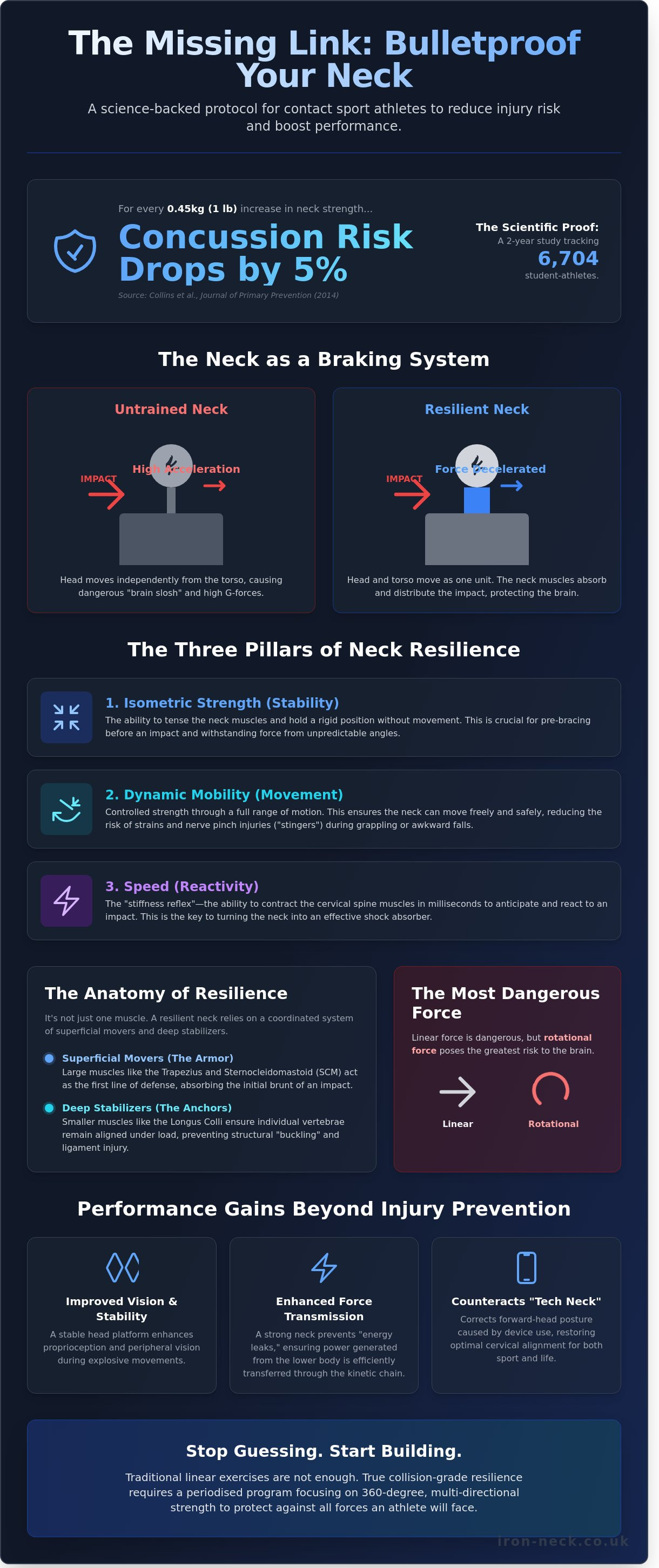
Data from the 2014 Collins study, published in the Journal of Primary Prevention, provides the scientific proof for this training. Researchers tracked 6,704 student-athletes across two years and found that for every one pound increase in neck strength, the risk of concussion dropped by 5%. Stronger stabilizer muscles also protect the brachial plexus, reducing the frequency of common nerve pinch injuries that sideline rugby players every weekend. Beyond the physical protection, a stable neck provides a massive psychological edge. When you trust your "chassis" to handle impact, you commit to tackles with 100% intensity rather than flinching or leading with poor form.
Concussion Prevention: The Science of G-Force Reduction
The brain sits in a bath of cerebrospinal fluid, making it highly susceptible to rotational forces. Neck muscles function as the body's primary shock absorbers for the head. By increasing the "stiffness" reflex, an athlete can anticipate an impact and contract the cervical spine muscles in milliseconds. This pre-activation effectively adds the mass of the torso to the head, significantly reducing the G-force experienced by the brain during a collision. It's a mechanical solution to a biological vulnerability.
Performance Benefits Beyond Injury Prevention
Focusing on building a resilient neck for contact sports also unlocks hidden performance gains. A stable neck improves proprioception and peripheral vision by keeping the head level during explosive movements. If your head wobbles during a sprint or a scrum, your visual tracking suffers. Additionally, a strong neck ensures better force transmission. Power generated in the lower body must pass through the spine to the point of contact; a weak neck acts as a "energy leak," dissipating the force you've worked so hard to build. For the modern athlete, this training also counters "Tech Neck," correcting the forward-head posture caused by hours of looking at devices—whether for game analysis or streaming entertainment from services like IPTV Nord—and restoring optimal cervical alignment.
The Biomechanics of Impact: How the Cervical Spine Absorbs Force
The cervical spine is more than a support pillar for the skull; it functions as a sophisticated shock-absorption system. When you're building a resilient neck for contact sports, you aren't just training for size. You're training for the ability to manage rapid energy transfer. The neck must transition from a state of mobility to one of absolute rigidity in milliseconds to protect the brain and spinal cord from trauma. This process relies on a hierarchy of muscle activation and structural alignment.
Force distribution begins with the superficial movers, primarily the sternocleidomastoid (SCM) and the upper trapezius. These large muscles act as the first line of defence, absorbing the initial brunt of an impact. However, the deep cervical stabilisers, such as the longus colli and longus capitis, are the true anchors. While the superficial muscles provide the "armour," these deep muscles ensure the individual vertebrae remain aligned under load. Without this internal stability, even the largest traps won't prevent the structural "buckling" that leads to ligamentous injury.
The physics of a hit are often categorised into linear and rotational acceleration. While a direct linear hit is dangerous, research on neck strength and concussions from Rutgers University suggests that a stronger neck significantly reduces the "whip" effect. Their data indicates that for every 1lb increase in neck strength, concussion risk can drop by 5%. This is because a strong neck effectively turns the head and torso into a single, heavier unit, reducing the acceleration of the brain inside the skull.
The Anatomy of a Collision
In a surprise impact, the body relies on a reflexive sequence of muscle activation. Ideally, the deep stabilisers fire first to "stiffen" the spinal column, followed immediately by the larger superficial muscles. The suboccipital muscles, located at the base of the skull, play a vital role here. They're densely packed with muscle spindles, making them essential for proprioception and rapid reaction. If these muscles aren't primed, the head will lag behind the body's movement, creating a whiplash effect even in a controlled sporting environment.
Many athletes focus solely on "yoked" traps, assuming that a large neck is a safe neck. This is only half the battle. Large muscles can provide mass, but if the neural drive to the deep stabilisers is slow, the head will still experience excessive displacement. True resilience requires the ability to maintain "isochoric" tension, where the neck muscles contract simultaneously to lock the cervical spine in place. To develop this specific type of 360-degree stability, many elite teams now utilise the Iron Neck UK & Europe training system as a foundational tool.
Rotational Torque and Brain Shear
The brain is far more vulnerable to rotational forces than linear ones. When a tackle or a punch causes the head to rotate sharply, it creates "shear" stress across the brain's white matter. This leads to axonal damage, which is a primary driver of long-term neurological issues. A resilient neck acts as a brake, providing the eccentric strength necessary to resist these "whipping" motions during a knockout blow or high-velocity tackle.
Proprioception in the cervical spine is the central nervous system’s ability to sense the head’s position and velocity in space, allowing for instantaneous muscular bracing before an impact occurs. Building a resilient neck for contact sports involves sharpening this sensory feedback loop. By improving the strength of the SCM and trapezius in all planes of movement, athletes can better distribute force through the shoulders and torso, rather than allowing the cervical spine to take the full load in isolation.
The Three Pillars of Neck Resilience: Strength, Mobility, and Speed
Building a resilient neck for contact sports requires more than just high-volume shrugs or basic stretching. It demands a sophisticated, three-pronged approach that mimics the chaotic environment of the pitch or the ring. If you neglect any single pillar, you create a structural weakness that opponents will eventually exploit. A truly protective armour for the cervical spine is built on the intersection of stability, range, and speed.
The three pillars represent the total functional capacity of your neck under duress:
- Pillar 1: Isometric Strength. This is your foundation. It provides the static stability required to keep the head and spine aligned during a scrum or a clinch. It acts as the primary braking system for the skull.
- Pillar 2: Dynamic Mobility. Contact isn't always linear. You need the tissue quality to absorb energy even when the neck is rotated or flexed at awkward angles. This pillar ensures that your muscles can produce force throughout their entire range of motion.
- Pillar 3: Reactive Speed. This is the "missing link" in most programmes. It's the nervous system's ability to switch on the muscles in the milliseconds before an impact occurs.
Relying on just one of these pillars leads to what coaches call a "glass neck." You might have the size of a heavyweight boxer, but if your reactive speed is slow, your head will whip back before your muscles even engage. Conversely, having great mobility without the isometric strength to stop movement is a recipe for ligament damage. You must train all three to ensure total protection.
Isometric vs Dynamic Training
Static holds build the structural integrity needed to resist high-velocity forces. Research published in The Journal of Primary Prevention (2014) by Collins et al. found that for every 1lb increase in neck strength, the risk of concussion decreases by 5%. This data highlights why building foundational tension is non-negotiable. However, you shouldn't stop at static holds. While isometrics create the "brakes," dynamic resistance training builds the "engine."
Most athletes fall into the trap of the bodybuilder approach, focusing purely on hypertrophy. A thick neck that lacks functional movement is a liability on the field. You need to transition from simple holds to controlled movements that challenge the cervical stabilisers through rotation and lateral flexion. This ensures that the 20+ muscles in your neck work in unison rather than as isolated units. Effective building a resilient neck for contact sports means ensuring those muscles are as functional as they are large.
Neuromuscular Timing: The Secret to Impact Survival
The brain's ability to brace before a seen impact is the primary differentiator between a minor collision and a season-ending injury. In a typical sporting impact, you have a window of roughly 80 to 100 milliseconds to prepare. If your Rate of Force Development (RFD) is slow, the impact energy is transferred directly to the brain rather than being dissipated by the musculature of the neck and shoulders.
The human brain can be trained to shorten the loop between perception and muscular activation. Training this requires drills that involve sudden load changes or external chaos. By using tools that provide 360-degree resistance, you force the nervous system to constantly adjust and "fire" the stabilisers. This improves proprioception, which is your body's internal GPS. When your brain knows exactly where your head is in space, it can brace more efficiently, making the process of building a resilient neck for contact sports a matter of neurological efficiency as much as physical power.
Designing a Periodised Neck Training Programme for Contact Athletes
Effective training isn't random. It requires a structured, three-phase approach to ensure the cervical spine can withstand the high-velocity impacts common in rugby, MMA, or boxing. Building a resilient neck for contact sports depends on progressive overload that respects the delicate anatomy of the upper spine while pushing for physiological adaptation.
The Foundation Phase: Safe Entry Points
Phase 1 (Weeks 1-4) focuses on motor control and stabilisation. We start with deep neck flexor activation through chin tucks and basic isometric holds to establish a baseline of pain-free range of motion. Athletes should use Iron Neck UK & Europe resistance bands for light corrective work; this provides a constant tension that forces the stabiliser muscles to engage throughout the entire movement. A 2014 study in the Journal of Primary Prevention found that for every one-pound increase in neck strength, concussion risk decreased by 5%. Starting with these controlled isometrics ensures the foundation is solid before adding dynamic load.
Weeks 5 to 8 shift the focus toward strength and hypertrophy. This is where we increase the cross-sectional area of the sternocleidomastoid and trapezius muscles. We utilise higher volume, typically 3 sets of 10-12 repetitions, to build the "armour" needed to absorb energy. The goal here is sheer force absorption. By increasing muscle mass in the cervical region, you create a larger surface area to dissipate the kinetic energy from a strike or tackle.
Advanced Protocols: Integrating Load and Speed
The final phase (Weeks 9-12) introduces power and reactive speed. We progress to rotational resistance and "Figure 8" movements that mimic the multi-planar forces experienced on the pitch or in the ring. This phase is critical for building a resilient neck for contact sports because it trains the brain and muscles to react to unpredictable movements. We also integrate eccentric load, where the athlete resists a force trying to move their head, simulating the "snap" of an impact. This builds the eccentric strength necessary to decelerate the head during a collision.
Managing fatigue is the most critical part of this advanced protocol. You should never train the neck to failure. The risk of injury to the cervical discs increases significantly when the supporting musculature is completely exhausted. Stop every set at least 2 repetitions short of technical breakdown. If your form wavers or your chin drifts, the set is over. Technical proficiency is the only metric that matters when loading the spine.
Alongside careful training management, supporting your recovery with high-quality nutrition is essential. For athletes looking for physician-formulated supplements to aid in muscle repair and reduce fatigue, MNM ProLabs offers a premium range designed for elite performance.
In-season maintenance requires a different strategy to avoid overfatigue. During the competitive season, we reduce training volume by 50% but maintain high intensity. One focused session per week is usually enough to retain the strength gains made in the off-season. This keeps the athlete protected without draining the central nervous system before match day. Consistency over these 12 weeks transforms the neck from a vulnerability into a performance asset.
Ready to upgrade your training toolkit? Explore the Iron Neck UK & Europe range to start building a stronger, safer foundation today.
Iron Neck: The Gold Standard for Multi-Directional Resilience
Traditional training often leaves a dangerous gap in an athlete's physical armour. While heavy shrugs and deadlifts build the trapezius, they fail to address the complex, multi-planar demands of the cervical spine. For athletes focused on building a resilient neck for contact sports, linear resistance is only half the battle. Real-world impacts in the scrum or the octagon don't just happen in straight lines; they involve rotational forces and unpredictable angles that a standard weighted harness simply cannot replicate.
The Iron Neck represents the "Missing Link" in modern strength and conditioning. Its patented 360-degree tracks allow for full range-of-motion training under consistent tension. This isn't just about size; it's about proprioception and stabilization. By forcing the small muscles of the neck to resist rotation, the device helps neutralise the whip-lash effect that often leads to concussions. Data from professional sporting environments suggests that every pound of neck strength gained can reduce concussion risk by up to 5%, making this equipment a non-negotiable for those in high-impact roles.
Elite UK Rugby Premiership teams and Cage Warriors veterans have shifted their protocols toward this scientific approach. They’ve moved away from archaic "bridge" exercises, which place unnecessary axial load on the spine, in favour of the Iron Neck’s controlled, variable resistance. It allows athletes to simulate the exact head positions they encounter during a tackle or a clinch, ensuring that building a resilient neck for contact sports is a functional, rather than just aesthetic, pursuit.
Iron Neck vs Traditional Methods
Standard head harnesses rely on gravity, meaning resistance only exists in a vertical plane. If you move your head side-to-side, the tension vanishes. The Iron Neck’s "Halo" design maintains constant tension regardless of your head's orientation. Its unique Friction Dial is the game-changer for progressive overload. By adjusting the dial, you can increase rotational resistance from zero to a level that challenges even the strongest heavyweight fighters. This specific focus on rotational torque is what builds the deep stabilisers required to keep the head still during a 20mph impact on the pitch.
Getting Started with Iron Neck UK
Choosing the right model depends on your specific performance goals and training environment. The Pro model is the industry standard for professional clubs, featuring the adjustable friction dial for maximum versatility. The Varsity model offers a fixed level of friction, ideal for team settings where rapid transitions are needed. For those training at home, the Starter model provides the essential linear resistance needed to begin your journey. Setting up your training gymnasium set is straightforward; the device anchors to any standard power rack or door frame in under 60 seconds.
- Iron Neck Pro: The ultimate tool for variable friction and rotational strength.
- Iron Neck Varsity: Built for durability and high-volume use in team gyms.
- Iron Neck Starter: Perfect for rehabilitation and foundational linear training.
Stop leaving your safety to chance. Whether you’re a front-row forward or a Brazilian Jiu-Jitsu specialist, your neck is your first line of defence against career-ending injuries. It’s time to train it with the same scientific rigour you apply to your squat or bench press. Explore the Iron Neck range and protect your future performance today. Your career depends on the stability you build now.
Secure Your Performance for the 2026 Season
The 2026 season demands more than traditional weightlifting. You've mastered the biomechanics of impact and the necessity of a periodised training programme. Building a resilient neck for contact sports is the foundational step to ensuring your career isn't cut short by preventable trauma. Peer-reviewed research published in the Journal of Primary Prevention indicates that every one-pound increase in neck strength can reduce concussion risk by 5%.
The Iron Neck Pro provides the multi-directional resistance required to meet these elite standards. It's the same technology trusted by all 32 NFL teams and top-tier Premiership Rugby clubs to protect their most valuable assets. With our dedicated UK-based support and rapid shipping across Europe, you can start your transformation this week. Don't neglect the most critical joint in your body. Take control of your physical longevity and step onto the pitch with total confidence. You've got the tools; now it's time to build your armour.
Build your resilient neck with the Iron Neck Pro today
Frequently Asked Questions
Is neck training safe for someone with previous whiplash injuries?
Neck training is safe and often recommended for whiplash recovery once you've received clearance from a GP or physiotherapist. You should start with isometric holds to stabilise the cervical spine before moving to dynamic movements. Research published in 2020 indicates that progressive resistance training can reduce chronic pain symptoms by 50% for those with historical whiplash injuries. It's the missing link for restoring range of motion and building long-term durability after a trauma.
How often should a rugby player train their neck during the season?
Rugby players should train their neck 2 to 3 times per week during the competitive season to maintain peak structural integrity. These sessions don't need to be long; 15 minutes of focused work is sufficient to offset the repetitive impacts of scrums and tackles. Maintaining this frequency ensures your stabilizer muscles remain reactive. It's about building a resilient neck for contact sports that can withstand the 20 to 30 high-impact collisions typical in a standard 80-minute match.
Can neck strengthening actually prevent concussions in contact sports?
Strengthening your neck is a proven strategy for reducing concussion risk by managing the energy of an impact. A landmark study of 6,700 high school athletes found that for every 1lb increase in neck strength, the risk of concussion dropped by 5%. Stronger muscles allow the head to decelerate more slowly during a collision. This reduces the "slosh" effect of the brain hitting the skull, providing a critical layer of protection for any elite athlete on the field.
What is the difference between an Iron Neck and a standard head harness?
The primary difference is that a standard head harness only provides linear resistance, while the Iron Neck allows for 360-degree movement and rotational training. Standard harnesses often neglect the small stabilizer muscles responsible for rotation and lateral flexion. By using a system that incorporates friction and 360-degree resistance, you address the missing link in traditional strength programmes. This holistic approach ensures your cervical spine is protected from every possible angle of impact.
Do I need a large neck to have a strong, resilient neck?
You don't need a thick, bull-like neck to possess elite levels of strength and resilience. While hypertrophy often accompanies training, the real goal is increasing the stiffness and reactive capability of the muscles. A 2018 study showed that isometric strength is a better predictor of injury prevention than simple neck circumference. Focus on the quality of the movement and the speed of muscle activation rather than just adding inches to your collar size to achieve building a resilient neck for contact sports.
At what age should young athletes start neck resilience training?
Young athletes can safely begin neck resilience training around the age of 12, provided they use age-appropriate, bodyweight, or light resistance protocols. This is the ideal window to develop proper motor patterns before they enter high-impact age grades in sports like rugby or MMA. Starting early builds the foundational posture needed for a lifetime of sport. Ensure all training is supervised by a qualified coach to maintain strict form and safety standards at all times.
How long does it take to see measurable results in neck strength?
You'll typically see measurable improvements in neck stability and strength within 4 to 6 weeks of consistent training. Initial gains are often neurological as your brain learns to recruit the stabilizer muscles more efficiently. An 8-week study involving collegiate athletes demonstrated a 25% increase in isometric neck strength using targeted resistance protocols. Consistency is the key to transforming your physical capacity and ensuring you're ready for the intense demands of the field.
Can I train my neck at home without a full gymnasium set?
You can absolutely train your neck at home using portable resistance equipment or high-quality elastic bands. A basic home setup can cost as little as £20 for bands or up to £300 for professional-grade tools like the Iron Neck. These tools allow you to perform essential isometric and rotational exercises in your living room or garden. This flexibility removes any excuses for skipping the foundational work required for injury prevention and high-level performance.