

Advanced Neck Strengthening Exercises: Elite Protocols for High-Performance Athletes
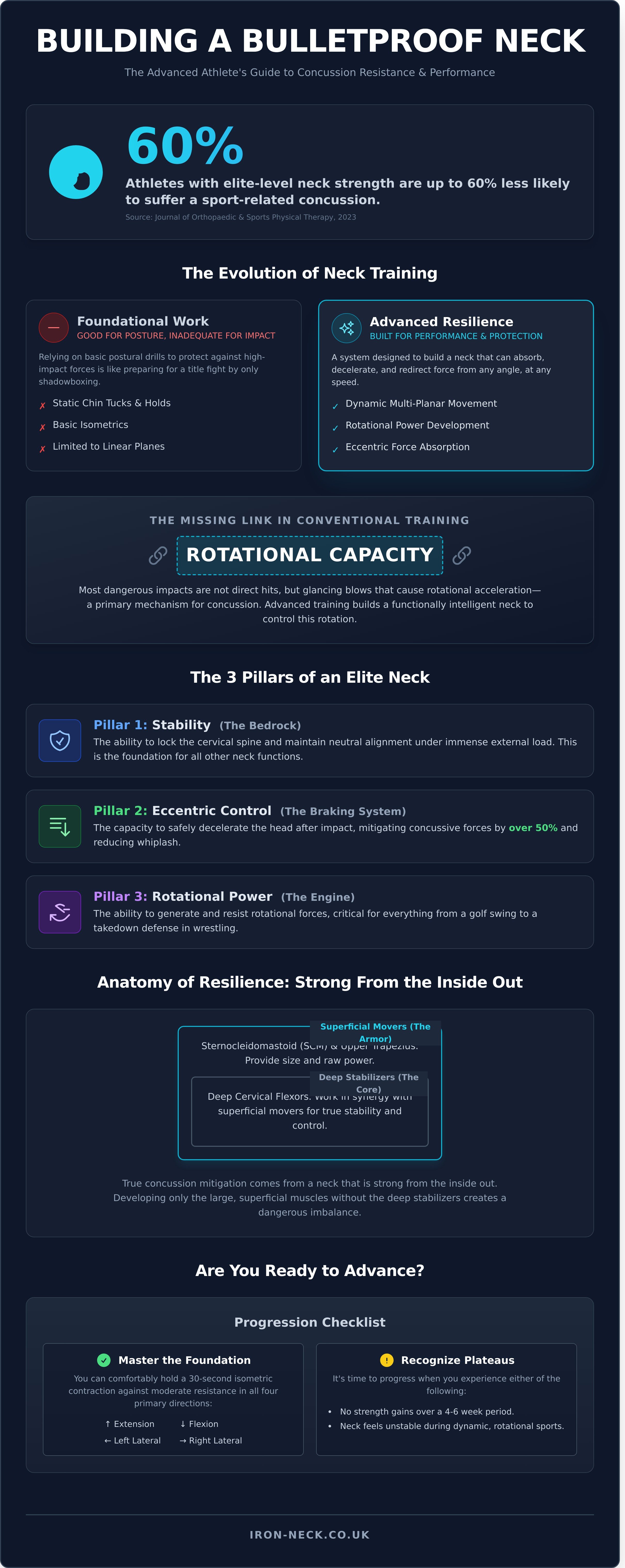
A 2023 study published in the Journal of Orthopaedic & Sports Physical Therapy revealed a stark reality: athletes with elite-level neck strength are up to 60% less likely to suffer a sport-related concussion. It's a truth you've likely felt in your own training. You've diligently used neck harnesses and performed basic isometrics, yet that nagging fear of cervical injury persists, and you've hit a frustrating performance plateau. You know there’s a missing link between your current routine and the elite stability you need.
This is where you break through. This guide moves beyond the fundamentals to deliver the sophisticated training protocols used by top-tier contact athletes. We will provide the exact framework you need to master advanced neck strengthening exercises, build a truly resilient cervical spine, and unlock measurable gains in power and protection. Get ready to explore multi-planar movements, rotational power development, and hypertrophy-focused routines that will forge a bulletproof neck.
Key Takeaways
- Discover why basic postural work fails to protect the cervical spine in high-impact sports and what separates foundational stability from elite resilience.
- Understand the critical difference between linear and rotational force and why multi-planar training is essential for building an impact-resistant neck.
- Unlock four elite advanced neck strengthening exercises used by professional athletes to build superior stability, power, and concussion resistance.
- Learn exactly how to program these movements, including the ideal training frequency and placement within your comprehensive strength and conditioning schedule.
Beyond the Chin Tuck: Defining Advanced Neck Strengthening
The standard chin tuck has its place. For correcting postural imbalances from hours spent over a screen, it’s a foundational first step. But for the serious athlete, relying on basic postural drills to protect against high-impact forces is like preparing for a title fight by only shadowboxing. A rugby tackle, a sudden G-force shift in a race car, or a header in football all subject the cervical spine to violent, unpredictable loads that static holds simply cannot prepare you for. True resilience isn’t about holding a perfect posture; it’s about controlling your head and neck through chaos.
This is the core of advanced neck training: a deliberate transition from static stability to dynamic, multi-planar resilience. It’s a system designed to build a neck that can absorb, decelerate, and redirect force from any angle, at any speed. While traditional strength programmes build a powerful chassis, they often ignore the critical suspension system that connects it to your most vital asset: your head. This oversight leaves a massive vulnerability in an athlete's kinetic chain.
The "Missing Link" in nearly all conventional strength and conditioning programmes is the systematic development of the cervical spine's rotational capacity. Athletes spend years building strength in the sagittal (forward and backward) and frontal (side-to-side) planes, yet the rotational movements that define elite sport are left to chance. This is where advanced neck strengthening exercises become non-negotiable. We must build a neck that is not just strong, but functionally intelligent. This intelligence is built upon three distinct pillars:
- Stability: The bedrock of all movement. This is the ability to lock the cervical spine and maintain neutral alignment under immense external load.
- Eccentric Control: The neck’s braking system. It’s the capacity to safely decelerate the head after an impact, reducing whiplash and mitigating concussive forces by over 50% according to some studies.
- Rotational Power: The engine of athletic performance. This pillar governs your ability to generate and resist rotational forces, critical for everything from a golf swing to a takedown defence.
The Anatomy of an Elite Athlete’s Neck
An elite neck is more than just thick. It’s a complex system where deep stabilising muscles, like the deep cervical flexors, work in perfect synergy with the large, superficial movers like the Sternocleidomastoid (SCM) and upper Trapezius. Building size in the SCM and traps without developing the deep stabilisers creates a dangerous imbalance. This dysfunction is a primary driver of cervical issues, a key factor in understanding neck pain and its causes. Thickening the neck is only half the battle; true concussion mitigation comes from a neck that is strong from the inside out. The suboccipital muscles, located at the base of the skull, are the final piece, acting as a high-speed GPS to fine-tune head position and enhance proprioception during explosive movements.
When to Progress from Foundational to Advanced Drills
Progressing to advanced neck strengthening exercises requires a solid foundation. The benchmark is the 30-second isometric hold standard: you should be able to comfortably hold a contraction against moderate, consistent resistance in all four primary directions (flexion, extension, and both lateral flexions) for 30 seconds without pain or form degradation. You know your current neck harness routine has plateaued when you no longer see strength gains over a 4-6 week period or your neck feels strong in linear movements but unstable during dynamic, rotational sports. For the athlete of tomorrow, the goal is clear.
Total Cervical Integrity for the 2026 athlete is the seamless integration of multi-planar strength, reflexive stability, and impact resilience, transforming the neck from a liability into a performance asset.
The Science of Multi-Planar and Rotational Resistance
Your cervical spine is an engineering marvel, designed for a complete 360-degree range of motion. It allows you to look, twist, and tilt with precision. Yet, most neck training protocols remain trapped in two dimensions, limited to simple forward (flexion) and backward (extension) movements. This linear approach creates a critical performance gap. It fails to prepare you for the forces you actually encounter in sport and life, which are rarely straightforward. True resilience is built by training for the complex, unpredictable nature of real-world impact.
Understanding the physics of impact is essential. A linear force is a direct push or pull. A rotational force, however, causes twisting. In sports like rugby or MMA, the most dangerous impacts are not the direct, head-on collisions; they are the glancing blows and tackles that whip the head sideways. This rotational acceleration is a primary mechanism for concussion. A 2015 study from the Stanford University School of Medicine confirmed that rotational forces, more than linear ones, are responsible for causing severe brain injury. Standard weight-plate exercises do little to prepare the intricate stabiliser muscles of the neck to counteract this violent twisting.
Training against rotational resistance does more than build muscle; it refines your nervous system. This type of training dramatically improves proprioception, your brain's internal GPS for your body. It heightens your spatial awareness of your head and neck, allowing for faster, more instinctual muscle contractions to protect the spine. By conditioning these neurological pathways, you effectively reduce the "whiplash" effect on the brain during an impact, minimising its movement within the skull and mitigating the risk of serious injury. These principles are the foundation of effective advanced neck strengthening exercises.
Rotational Power: The Key to Concussion Mitigation
The scientific evidence is clear: a stronger, stiffer neck is a safer neck. Research consistently links increased neck strength and girth to a significant reduction in concussion risk. For every 4.5N (1 lb) increase in neck strength, a 2014 study in the Journal of Orthopaedic & Sports Physical Therapy found that the odds of concussion decreased by 5%. Leading research into neck strength for concussion prevention continues to validate this principle. This training also enhances "Anticipatory Postural Adjustments," the subconscious bracing your body performs milliseconds before an impact. A system like the Iron Neck, with its unique circular track, is engineered to apply this essential rotational load through every plane of motion.
Eccentric Load and the Cervical Spine
The most overlooked phase of any movement is often the most critical for injury prevention: the eccentric phase. This is the "lowering" or "braking" part of a repetition, where the muscle lengthens under tension. In high-velocity sports, your ability to manage deceleration forces, like controlling your head's movement after being tackled, is paramount. Building eccentric strength creates more resilient muscle fibres and superior neurological control. The key to introducing this safely is with smooth, consistent resistance that allows you to control the movement without compromising the integrity of your spinal discs.
Moving beyond basic 2D movements is not just an option; it's a necessity for anyone serious about performance and protection. By incorporating multi-planar, rotational, and eccentric loads, you build a functionally strong neck that is prepared for the dynamic chaos of sport. This holistic approach is fundamental to all elite-level advanced neck strengthening exercises, and it’s precisely what our training systems are engineered to develop, closing the gap between gym strength and on-field resilience.
Advanced Modalities: Comparing Harnesses, Bands, and the Iron Neck
Once you've mastered foundational movements, unlocking the next level of neck strength and resilience demands specialised equipment. Bodyweight exercises build a solid base, but for elite athletes and those serious about injury prevention, targeted resistance is non-negotiable. The tools you choose directly dictate the results you can achieve. Let's break down the three primary modalities: traditional harnesses, versatile resistance bands, and the comprehensive Iron Neck system.
Traditional Head Harnesses: The Linear Strength Builder
A quality head harness, like the Alpha Head Harness, is a powerful tool for a very specific job: building raw, linear strength. Its primary function is to add load to straightforward neck flexion and extension. This is ideal for pure hypertrophy, targeting the sternocleidomastoid and splenius muscles with heavy, controlled negatives. For powerlifters aiming to build a stronger yoke, a harness provides a direct and effective stimulus. However, its limitations become clear in any athletic context. It offers zero rotational resistance, leaving the crucial stabiliser muscles untrained. Furthermore, during dynamic movements, the harness can slip, compromising form and potentially increasing injury risk.
The Iron Neck Advantage: 360-Degree Foundational Strength
The Iron Neck was engineered to solve the fundamental limitations of every other tool. It's not just an upgrade; it's a complete paradigm shift in how we approach neck training. Its patented design delivers a holistic solution that harnesses and bands simply cannot replicate.
- Friction-Dial System: Unlike the static load of a harness, Iron Neck's adjustable friction dial provides smooth, concentric and eccentric resistance through every degree of rotation. This trains the neck to resist the torsional forces that cause whiplash and concussions, a critical component missing from all other advanced neck strengthening exercises.
- Upright, Athletic Training: The halo design is a game-changer. It allows you to train in an upright, athletic stance, engaging your entire kinetic chain from the ground up. This builds functional strength that translates directly to the field, ring, or pitch, improving proprioception and core stability simultaneously.
- 4-in-1 Clinical Application: For professional rehabilitation, its efficiency is unmatched. The Iron Neck consolidates four key treatment goals into one device: strengthening, injury prevention, posture correction (eliminating "tech neck"), and mobility-focused recovery.
This comprehensive approach is why over 500 professional sports teams and leading UK physiotherapy clinics, including those servicing Premiership Rugby, trust Iron Neck. It addresses the neck as the complex, multi-directional foundation of all movement.
For a professional club, the cost-benefit analysis is simple. A standard, high-quality head harness costs between £25 and £50, offering a limited, linear benefit. The Iron Neck 3.0 Pro, starting at £599, is a strategic investment in athlete longevity. The cost is marginal compared to losing a key player for even a single match due to a preventable neck injury or concussion. For the serious home gym owner, it replaces multiple pieces of equipment and delivers a level of preventative training and performance enhancement previously reserved for elite facilities. It's the definitive tool for anyone committed to building a truly resilient, high-performance body.
The Elite Protocol: 4 Advanced Neck Drills for Athletes
Basic neck bridges and static holds build a foundation. But for the serious athlete, the combat professional, or anyone demanding peak resilience, a foundation isn't the final destination. It's the launchpad. The protocol outlined here represents the next evolution in performance training, focusing on dynamic, multi-planar movements that build a truly functional and powerful neck. These aren't just exercises; they are neurological upgrades designed to enhance stability, rotational power, and impact absorption. This is where the world's top 1% of performers find their competitive edge.
Drill 1: The 360-Degree Spin
This movement trains the entire cervical musculature through a full, controlled range of motion under constant tension. It's a masterclass in motor control and builds the endurance needed to maintain head position under fatigue. Forget momentum; precision is the goal.
- Step 1: Assume an athletic stance, core engaged, with resistance applied from an anchor point directly in front of you.
- Step 2: Begin by tucking your chin, then slowly trace a circle with your nose. Lead with your chin down to your chest, across to one shoulder, up towards the ceiling, across to the other shoulder, and back down.
- Step 3: The movement must be fluid and deliberate. A single rotation should take 8-10 seconds.
A common mistake is initiating the rotation with the shoulders or torso. The power of this drill comes from isolating the movement to the cervical spine, forcing the smaller stabiliser muscles to perform. For optimal results, program 3 sets of 5 slow rotations in each direction, focusing on quality over quantity.
Drill 2: The Isometric Body Turn
This drill teaches your body the critical skill of "locking" the head and neck in a fixed position while your torso rotates. It directly simulates the forces experienced during a tackle, a takedown, or a high-G turn, training the neck to act as an immovable anchor for the spine. The core and glutes are essential partners, creating a stable base that allows the neck's isometric contraction to be the primary focus.
For a front-row rugby player, this drill is the difference between dominating the scrum with a unified kinetic chain and suffering a catastrophic loss of power through a weak cervical link.
Drill 3: Advanced Protraction/Retraction
The standard chin tuck is a vital rehabilitative tool. This is its high-performance evolution. By adding controlled, linear resistance, you move beyond simple activation into true strengthening of the deep cervical flexors (DNCF). These muscles are fundamental for maintaining a neutral spine and preventing the forward-head posture that plagues over 90% of modern athletes and office workers.
The key is to execute the movement by pushing and pulling your head in a straight line, without tilting up or down. Maintain a packed chin and neutral spine throughout. One safety tip is paramount: never "grind" through pain or a clicking sensation at the end-range of protraction. Reduce the resistance or range of motion until the movement is clean and pain-free.
Drill 4: The Diagonal Pull
True neck strength is never isolated. It's integrated with the power of the upper back. The Diagonal Pull forges this critical connection, strengthening the neck's rotational capacity while activating the trapezius and rhomboids. This is one of the most effective advanced neck strengthening exercises for athletes in rotational sports like MMA, jiu-jitsu, and baseball. To perform it, anchor a resistance band to your side at chest height. Look towards the anchor point and slowly rotate your head away, pulling diagonally across your body. The movement creates a powerful co-contraction from your sternocleidomastoid down through your thoracic spine.
Executing these advanced movements with precision requires equipment that can deliver smooth, 360-degree resistance. See how the Iron Neck 3.0 Pro is engineered to unlock this elite level of performance safely and effectively.
Programming Your Advanced Neck Training for 2026
Executing exercises is only half the battle. Elite performance is built on intelligent programming. A structured plan is what separates haphazard effort from genuine athletic enhancement, especially with advanced neck strengthening exercises. To build a truly resilient and powerful neck, you need a protocol that adapts to your competitive calendar and integrates seamlessly with your total body training.
For a competitive athlete, the neck should be trained directly 2-3 times per week. These are not gruelling, hour-long sessions. They are precise, targeted attacks on weakness. Neck work fits perfectly as part of a dynamic warm-up to improve proprioception before a lift, or as a finisher on an upper body day to exhaust the stabiliser muscles. The key is consistency, not total annihilation.
Your training must also be periodised. The demands of the off-season are vastly different from those in-season.
- Off-Season: This is your building phase. The focus is on hypertrophy and foundational strength. Volume is higher (e.g., 3-4 sets of 8-12 reps) and intensity is progressively overloaded. This is where you build the raw material for in-season resilience.
- In-Season: The goal shifts to maintenance, activation, and recovery. Volume drops significantly (e.g., 2 sets of 8-10 reps) to avoid excessive fatigue, but frequency can remain. The focus is on isometric holds and controlled rotational movements to keep the nervous system firing without creating muscle soreness that could impact game-day performance.
This is where efficiency becomes non-negotiable. Athletes don't have time for inefficient methods. The Iron Neck is the definitive solution, allowing you to target strength, stability, and mobility in a single, fluid 10-minute session. It delivers a higher return on investment than any other tool, making it the cornerstone of a modern athlete's programme.
Sample Weekly Advanced Protocol
This protocol integrates different training modalities to build a completely developed neck. It's designed to be performed on non-consecutive days, allowing for at least 48 hours of recovery between sessions.
- Day 1: High-Intensity Rotational Power. Focus on explosive, sport-specific movements. Using the Iron Neck, perform 3 sets of 360° Spins and Look Left, Look Right movements against moderate-to-high resistance, emphasizing speed and control.
- Day 2: Hypertrophy and Linear Strength. This is your foundational strength day. Using a neck harness and resistance bands, perform 3-4 sets of 10-12 reps of Neck Extensions, Flexions, and Lateral Flexions, focusing on a slow, controlled tempo.
- Day 3: Mobility and Isometric Stability. This session enhances control and endurance. Perform Iron Neck Body Turns and Figure 8s for 2-3 sets of 45-60 seconds. The goal is smooth, pain-free motion and unwavering core-to-cervical stability.
Tracking Progress and Measuring Success
What isn't measured can't be improved. Your neck training requires objective data and subjective feedback to ensure progress. Track these key performance indicators:
- Neck Circumference: While not a direct measure of strength, a 1-2 cm increase in neck circumference during a 12-week off-season block is a reliable proxy for muscle hypertrophy.
- Subjective Feedback: Athletes in contact sports often report a reduction in post-contact "brain fog" or dizziness as their neck strength improves. This is a critical, real-world indicator of increased resilience.
- Objective Performance: The most direct metric. Log the resistance levels used. On the Iron Neck, this means tracking the friction dial setting. A measurable increase every 2-4 weeks signals positive adaptation.
Your neck is the missing link in your performance armour. A weak foundation puts the entire structure at risk. It's time to build from the ground up. Ready to upgrade your training and unlock your true potential? Shop the Iron Neck collection for UK & Europe.
Forge Your Competitive Edge for 2026
You now have the blueprint for elite cervical spine conditioning. The path to peak performance and injury resilience isn't built on simple chin tucks; it's forged through multi-planar resistance and rotational strength. Implementing these advanced neck strengthening exercises is the non-negotiable next step for any serious athlete aiming for dominance in their sport.
While harnesses and bands offer linear resistance, achieving true 360-degree dynamic strength requires a purpose-built solution. That’s why elite athletes in the NFL, UFC, and Premiership Rugby rely on the science-backed design of Iron Neck. As the #1 choice for cervical spine rehabilitation professionals, it’s the proven tool for building foundational power and reducing injury risk.
Stop leaving your performance to chance. Unlock your full potential with the Iron Neck 3.0 and build the powerful, resilient neck that champions demand.
Frequently Asked Questions
Is it safe to do advanced neck exercises every day?
No, it's not recommended to perform high-intensity neck exercises daily. Your cervical spine muscles require adequate recovery time to repair and grow stronger, just like any other muscle group. Overtraining can lead to strain and diminish performance gains. For optimal results and safety, most athletes should aim for 2-3 non-consecutive sessions per week, allowing at least 48 hours of recovery between workouts. Always listen to your body and prioritise recovery.
Can advanced neck training really help prevent concussions?
Yes, a stronger neck is scientifically proven to reduce concussion risk. While no training can eliminate the risk entirely, strengthening the neck muscles improves your ability to absorb and dissipate impact forces, reducing head acceleration during a collision. A 2014 study in the Journal of Primary Prevention found that for every one-pound increase in neck strength, the odds of concussion decreased by 5%. This makes a strong neck a critical line of defence for any contact sport athlete.
What is the difference between a neck harness and the Iron Neck for advanced users?
The key difference lies in the training dynamic. A traditional neck harness is limited to linear, two-dimensional movements like flexion and extension. The Iron Neck provides 360-degree rotational resistance, allowing you to train in every plane of motion. This holistic approach engages the deep stabiliser muscles of the cervical spine, improving proprioception and building foundational strength that a harness simply cannot replicate. It's the difference between basic strength and true athletic performance.
How long does it take to see results from advanced neck strengthening?
Athletes often report feeling increased stability and reduced neck soreness within the first 2-4 weeks of consistent training. Measurable strength gains, such as the ability to handle more resistance with perfect form, typically become evident after 6-8 weeks of a dedicated protocol (2-3 sessions per week). True foundational strength is built over months, not days. Consistency is the absolute key to unlocking long-term improvements in both performance and resilience.
Should I do neck exercises before or after my main workout?
You should perform dedicated neck strengthening after your main workout or as a standalone session. Training your neck to fatigue before performing major compound lifts like squats or deadlifts can compromise the stability of your cervical spine. This increases your risk of injury during those heavy lifts. By treating neck training as specialised accessory work, you ensure your stabiliser muscles are fresh when you need them most, promoting both safety and peak performance.
Are these exercises suitable for people with a history of whiplash?
It's essential that you consult a qualified physiotherapist or medical professional before beginning any advanced neck protocol. While strengthening the neck is a critical component of long-term recovery from whiplash, improper execution or premature loading can easily cause re-injury. A professional can provide a clinical assessment and a progressive, tailored plan to help you safely rebuild foundational strength and restore function, ensuring you are ready for more advanced work.
What is the most common mistake athletes make in advanced neck training?
The single most common mistake in advanced neck strengthening exercises is prioritising excessive resistance over perfect form. Athletes often use momentum or "jerking" motions to move the weight, which fails to properly activate the deep cervical muscles and dramatically increases injury risk. Every repetition must be smooth, deliberate, and controlled through a full range of motion. Elite performance is built on precision, not just brute force. Master the movement before you add significant load.
Do I need a coach to start advanced neck protocols?
While not strictly required if you follow instructions carefully, guidance from a qualified strength coach or physiotherapist is highly recommended. A professional provides real-time feedback on your form, which is critical for safety and efficacy when performing advanced neck strengthening exercises. They can also help design a programme specific to your sport's demands, helping you progress more than 50% faster and ensuring you build a truly resilient and high-performing neck.